
Funding Big Ideas for Real Impact
We're funding projects that help people with dementia use technology to live more independently.
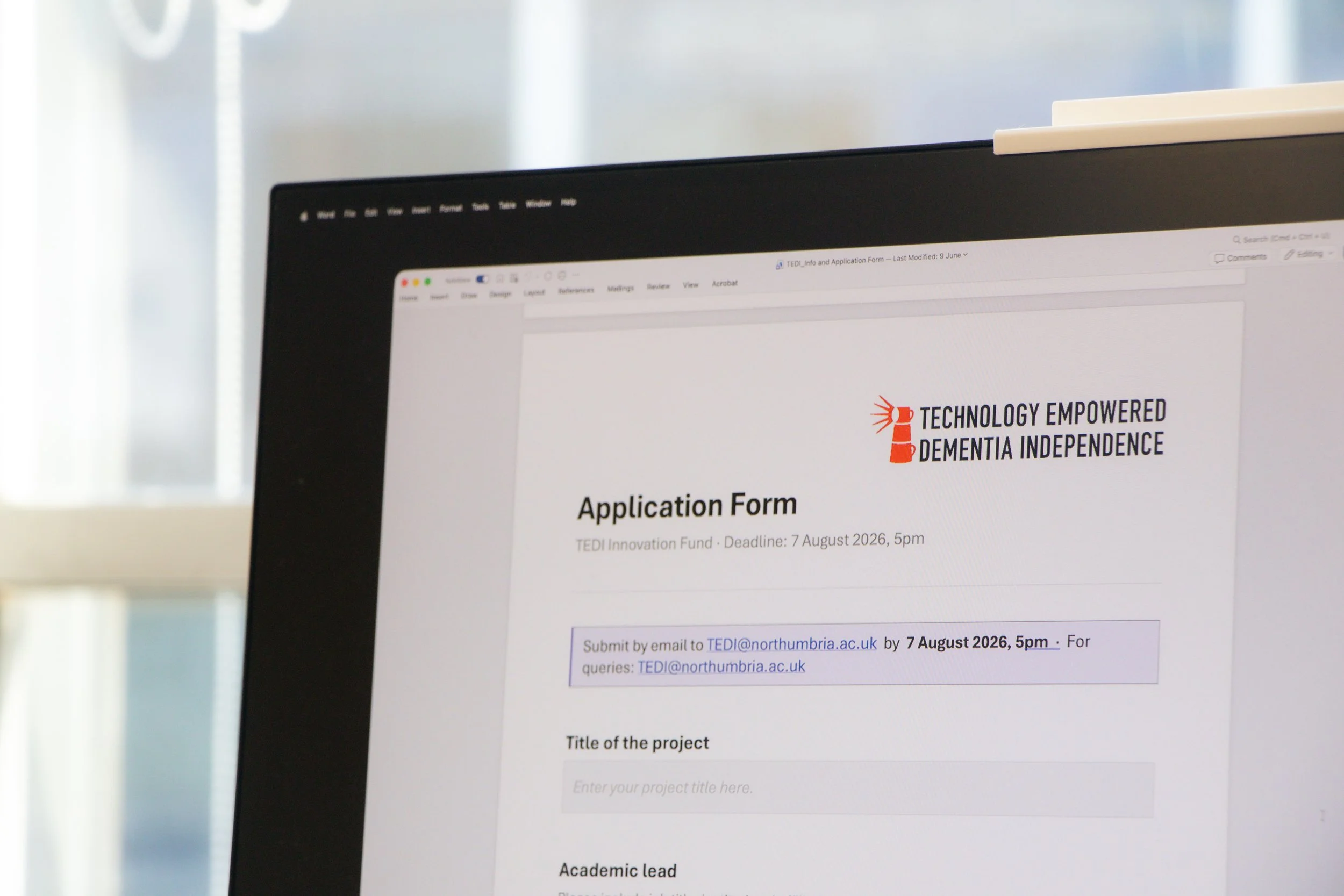
Applications for the TEDI Innovation Fund are now closed.
Thank you to all those who submitted an application. We'll be in touch with all applicants in due course.
Key dates
29th May Expression of Interest deadline
12th June Matchmaking notification made to teams
June & July Application support resources available
7th August Application deadline
8th September Review period commences
21st September Grant funding panel
28th September Lived experience panel
9th October Decisions communicated to applicants
January 2027 Projects begin
December 2027 Projects end

Technology Empowered Dementia Independence (TEDI) Innovation Fund
We are funding projects of up to £100,000 to support projects that help people with dementia to live more independently.
We are funding projects that align with one or more of our four technology domains: Inequity, Independence, Innovation, and Integration. You can find out more about TEDI’s guiding principles, and what each of these means in practice on our About page.
People with dementia are central to this fund — as applicants, as partners, and as reviewers.
We have encouraged those with lived experience of dementia, researchers, businesses, charities, or policy-makers to apply.
This funding is part of a wider research investment supported by EPSRC, Alzheimer's Society, and NIHR, designed to meaningfully impact the future of living with dementia through innovation.
TEDI will fund 80% of Full Economic Cost (FEC) - so with a maximum project budget of £100,000, TEDI will contribute up to £80,000, with the remaining £20,000 (20%) funded by the lead institution. Projects can run for up to 12 months.
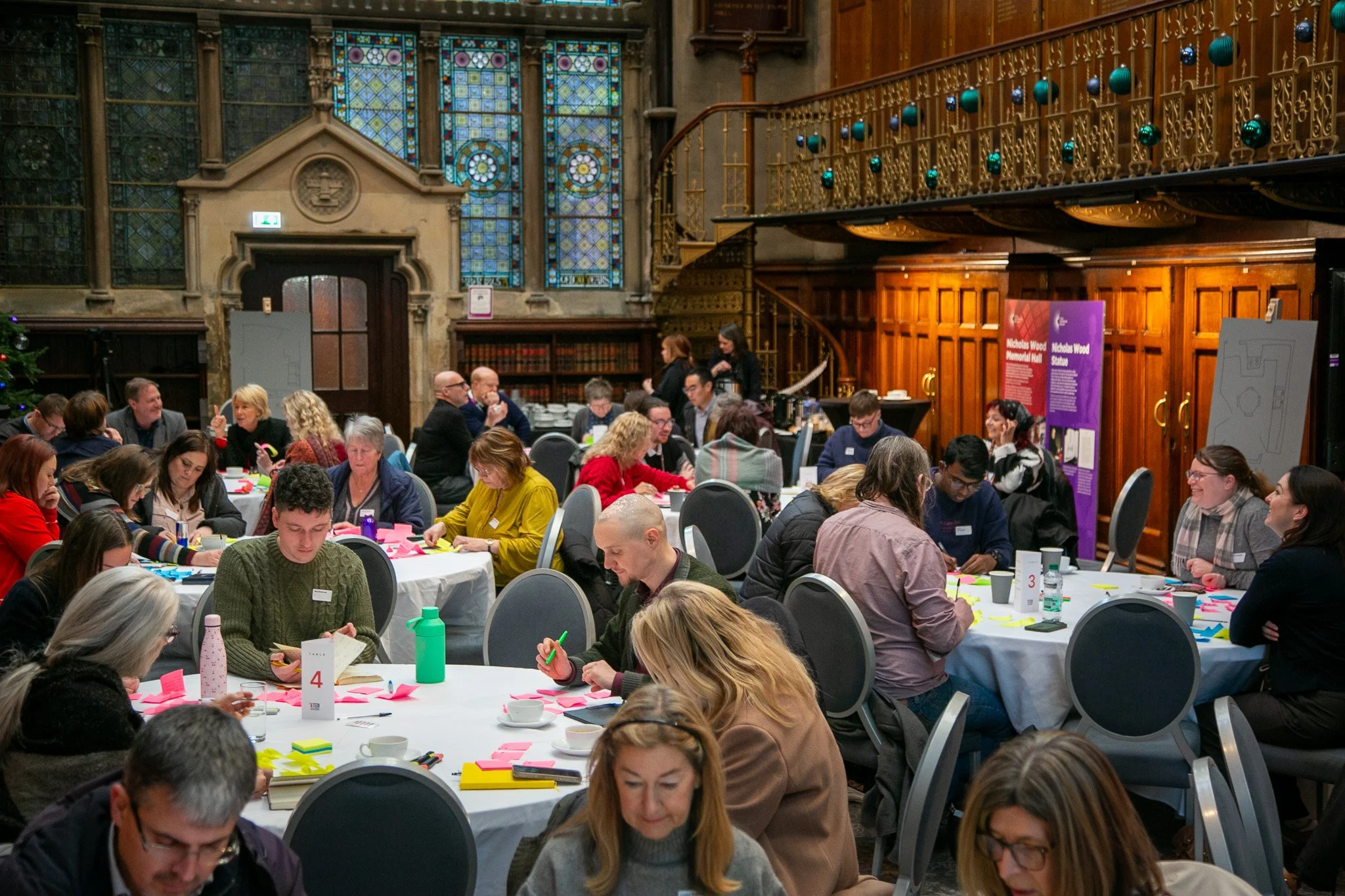
TEDI Launch Event, November 2025
What sort of projects are we funding?
Projects which develop, or test, technologies that support the independence of people living with dementia. For example - but not limited to:
Apps
Mobility tools
Digital education courses
Community programmes
Digital education courses
Remote monitoring technologies
Projects which are meaningfully co-produced with people with lived experience of dementia.
Achievable within 12 months and the funding available
Aligned with one of our four core themes
We favour applications which:
Address inequalities experienced by people living with dementia from under-served communities
Enhance the lives of people living with dementia in the North East of England and North Cumbria

Who can apply?
Applications are now closed. Thank you to everyone who took part — we'll be in touch with all applicants in due course as the review process progresses.
Who can a team include?
Teams may include:
People with lived experience of dementia — as partners and co-designers, not just participants
Researchers
Community or voluntary sector partners
Technology developers or innovators
An academic lead who meets UKRI eligibility criteria (see below)
Collaborators from the NHS, industry, community organisations, or the third sector are welcome — even if they are not eligible for UKRI funding in their own right. Their costs can be included via subcontracting through the lead institution.
Academic lead eligibility
Each application must be led by an academic who is:
An employee (lecturer or equivalent) at a UK higher education institution or eligible UK research organisation
Resident in the UK
Eligible to apply for EPSRC grant funding
Application Stages
-
Kick-Off Talks have now concluded - though all the information you need is available on this page.
Instead of a kick-off talk, our Innovation Fund Intro, presented by Arlene, is a great place to start.
If you're thinking about applying or have questions about the fund, please get in touch directly at TEDI@northumbria.ac.uk — we're happy to talk through your idea at any stage before the 7th August deadline.
-
EOIs are now closed. Matchmaking outcomes will be shared with those who submitted an EOI by 12th June 2026. If you have a question or are looking for collaborators, please get in touch at TEDI@northumbria.ac.uk
-
Matchmaking is how we help people find the right collaborators.
Now the EOI deadline has passed, we're looking at everyone who submitted an idea and connecting people who are working in similar areas. This might mean introducing you to a researcher, a community group, a policy maker, or a company - whoever might be the right fit for your project.
Matchmaking is ongoing leading up to full applications. We're starting with simple email introductions, and suggesting teams set up meetings as a starting point. From there, you may choose to form a collaboration and build a project proposal together.
This step is optional - but we think it's especially valuable if you've never worked on a research project before. You don't need to arrive with a ready-made team. That's what matchmaking is for.
Our matchmaking service works in both directions. If you have an idea but don't yet have the right partners to develop it, we're helping connect you with researchers, designers, technology companies, or community organisations who share your interests.
Matchmaking also works the other way. If you are a researcher or company with a technology concept, we're helping connect you with people who have lived experience of dementia - including carers, family members, and people living with dementia themselves - to make sure your idea is grounded in real need and developed with the people it is designed to serve.
If you have questions about matchmaking, or would like to ask about an introduction, email us at TEDI@northumbria.ac.uk
-
To help you write the strongest application possible, we will make training materials available through June and July:
Innovation Fund Introductiongiving an overview of TEDI, the innovation fund, and the application process.
Budget guidanceexplaining project management approaches to support your project, explaining what costs are eligible, and how to calculate FEC.
Writing a Strong Applicationcovering each section of the application form and showing what a strong application looks like.
Ethics of Technology and Dementia to help our network members and applicants navigate the intersections specific to this area.
Co-Production Alongside People with Dementia, explaining collaborative approaches in person-centred design, and introducing workable methods for your team to embed person-centredness in your study design in line with TEDI’s mission.
Keep an eye on your inbox for updates on resources as they are made available. You can find all the currently published resources on our Resources page.
-
Download our application form, complete it in your own time, and email it to us when you are ready.
The form includes:
Information about the fund
Your team and expertise
Your aims and objectives
How your project will be co-produced
Your budget with justification
A plain English case for support (maximum 1,500 words), structured in four sections
Your project timeline
How your project connects to TEDI themes and guiding principles
The form includes guidance notes and worked prompts for each section. Complete it in your own time and email your finished application to: TEDI@northumbria.ac.uk by 7th August 2026, 5pm
Application process, step-by-step
Applications are now closed.
Thank you to everyone who took part — we'll be in touch with all applicants in due course as the review process progresses.
What makes a strong application?
Our assessment panels will score each application across five areas:
Study Design, Feasibility and Value for Money (30%)
Clarity and relevance of aims, aligned with an identified need. Appropriateness and rigour of methods. Feasibility within proposed timeframe and resources. Clear evaluation plan. Budget is justified, proportionate, and aligned with project activities. Evidence of access to required populations, settings, or data. Identification and mitigation of key risks.
Co-production and TEDI Alignment (25%)
Meaningful integration of lived experience across all stages of the project. Clear roles, equitable collaboration, and realistic co-production plans. Alignment with TEDI mission to support independence at home. Strong justification for relevance to TEDI priorities.
Equity and Inclusion (20%)
Consideration of diverse and under-served populations, particularly those relevant to North East and Cumbria. Evidence of an intersectional approach (e.g., socioeconomic status, geography, digital access). Strategies to address accessibility and digital exclusion. Plans to ensure inclusivity in design, recruitment, and implementation.
Impact and Translation (15%)
Clear pathway to impact for people living with dementia. Potential for real-world implementation or scalability. Consideration of sustainability and future development. Potential for follow-on funding or integration into care pathways.
Team Capability (10%)
Appropriateness of team expertise and roles.
Get in touch
If you have a question about the fund, please get in touch.
-
Absolutely — and we want to hear from you. You do not need to be a researcher or have a project idea to submit an expression of interest. If you want to get involved in shaping a project, tell us a little about yourself and we will do our best to connect you with a team.
-
No. If you are unsure about your team, get in touch — we can still help connect you with collaborators before the 7th August deadline.
-
Community organisations, charities, and voluntary sector partners are warmly encouraged to get involved — but the lead applicant must be an academic employee at an eligible UK institution. If you are from a community organisation and want to find a research partner to lead an application, get in touch and we can help make introductions.
-
No — the fund is open to projects from across the UK. However, we will give special consideration to projects that benefit people living with dementia in the North East of England and North Cumbria.
-
Co-production means that people with lived experience of dementia are genuine partners in shaping the project — not just consulted or recruited as participants. This includes being involved in the design, delivery, and evaluation of the work. It is one of our most important assessment criteria. We will be sharing resources to help you think through what this means in practice.
Please see our Co-production Resource for more guidance.
-
We are open to a wide range of digital technologies — from apps and wearables to smart home devices, assistive tools, and data platforms. The key question is whether it has the potential to support independence for people living with dementia in their own homes.
-
Yes. The £100,000 figure is a maximum total project budget. We welcome applications for smaller amounts, and your budget should be proportionate to what you are actually doing.
-
FEC stands for Full Economic Cost — a standard way of calculating the true cost of a research project, including staff time, overheads, and other expenses. UKRI funds projects at 80% of FEC, which means your institution contributes the remaining 20%.
For example, on a maximum £100,000 project, TEDI would fund £80,000 and your institution would fund the remaining £20,000.
Our budget guidance resource explains this in more detail.
-
Yes, but each application must be for a distinct project with its own team and aims.
-
All applications go through a two-stage review process designed to bring together expert knowledge and the perspectives of people living with dementia.
In the first stage, a review panel of experts will independently score every application against our five assessment criteria before the panel meets. The panel brings together expertise spanning primary care, digital technology, social science, design, community and voluntary sector practice, and dementia research. Panel members will declare any conflicts of interest and will not score applications where a conflict exists.
In the second stage, a shortlist of the strongest applications will be reviewed by a lived experience panel — a small group of people living with dementia, recruited from community groups across the North East and North Cumbria. This is a closely facilitated half-day session, and the lived experience panel will have the final say in which projects are funded. Their feedback is mapped directly to the assessment criteria.
-
We aim to communicate decisions to all applicants by 25th September 2026. All applicants will feedback on their application regardless of outcome.
-
We take the handling of your ideas seriously. While submitting an expression of interest to TEDI does not in itself transfer any intellectual property rights to Northumbria University or any partner organisation, we want to be transparent about how ideas are used once received.
The purpose of the Innovation Fund is to connect ideas with the right people to help develop them. This means your expression of interest will be read by the TEDI review panel, and if taken forward, your idea may be shared through our matchmaking process to help identify suitable academic, community, or industry partners. We will endeavour to keep you informed at each stage of this process and will aim to involve you in decisions about how your idea is shared before that happens.
If you have concerns about a particularly sensitive idea, we would encourage you to get in touch with us before submitting — we are happy to talk through how the process works and answer any questions.
-
Yes. If you are a researcher, designer, or technology company looking to develop or test an idea, we can help connect you with carers, family members, and people living with dementia who can contribute their experience as partners in your project. Lived experience isn't an add-on — it's central to what the Innovation Fund is trying to achieve.